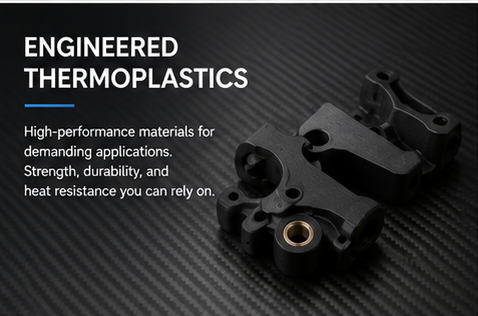
Engineered Thermoplastics

Select from our rigorous library of production-grade materials. Every filament and resin is qualified for dimensional accuracy, mechanical performance, and environmental resilience in industrial applications.

START YOUR PRODUCTION RUN
Technical Comparison

A comprehensive guide for 3D printing professionals to choose the optimal material for functional prototyping and industrial applications.


Material Strength Flexibility Durability Difficulty
PLA 8/10 1/10 4/10 Very Easy
PETG 9/10 4/10 9/10 Moderate
ABS 9.5/10 3/10 9.5/10 Challenging
TPU 5/10 10/10 9.8/10 Difficult


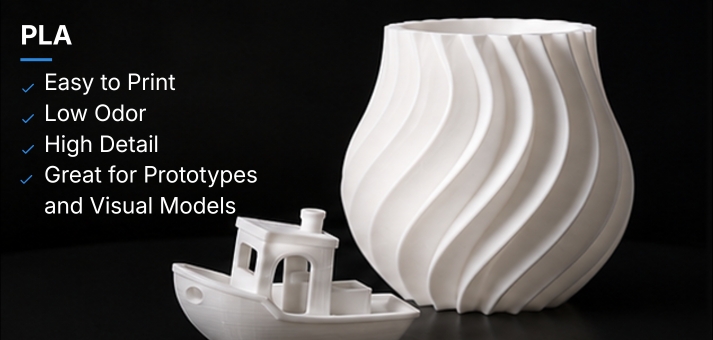
PLA

Polyactic Acid


Nozzle Temp 190 - 220°C
Bed Temp 20 - 60°C
Print Speed 60 mm/s
Tensile Strength 65 MPa
Heat Deflection 55°C
Flexural Modulus 3150 MPa
Density 1.24 g/cm³

Best Use Cases

Ideal for aesthetic prototypes, architectural models, and beginner projects. Its bio-based nature makes it the go-to for indoor office environments.

Limitations

Low heat resistance (softens at 60°C). Brittle nature makes it unsuitable for high-impact functional parts or outdoor use.

Typical Applications

Education, Visual Prototypes, Consumer Goods, Tabletop Gaming

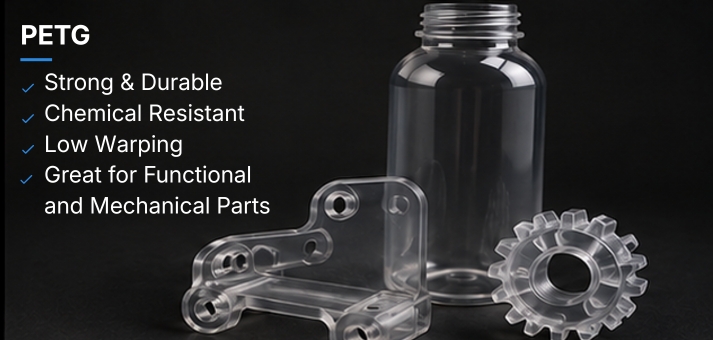
PETG

Polyethylene Terephthalate Glycol


Nozzle Temp 230 - 250°C
Bed Temp 70 - 90°C
Print Speed 45 mm/s
Tensile Strength 50 MPa
Heat Deflection 70°C
Impact Strength High
Flexural Modulus 2100 MPa

Best Use Cases

The perfect middle ground. Use for parts requiring water resistance, higher thermal stability than PLA, and better impact resistance.

Limitations

Prone to 'stringing' and can adhere too strongly to print beds. Significant 'oosing' requires careful retraction tuning.

Typical Applications

Food Containers, Outdoor Housings, Medical Devices, Mechanical Guards

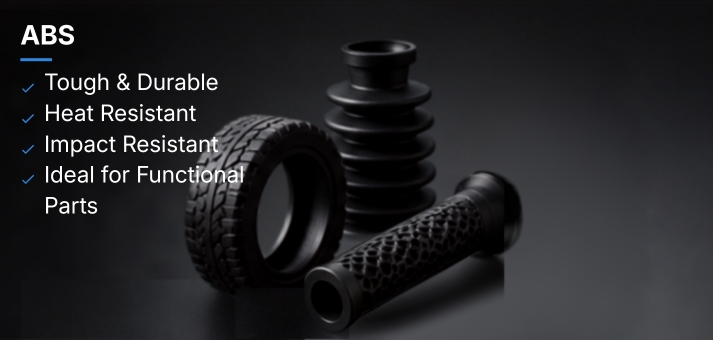
ABS

Acrylonitrile Butadiene Styrene


Nozzle Temp 240 - 270°C
Bed Temp 100 - 110°C
Shrinkage 0.5 - 0.7%
Tensile Strength 40 MPa
Heat Deflection 98°C
Machinability Excellent
Density 1.04 g/cm³

Best Use Cases

Functional parts exposed to high heat or mechanical stress. Can be post-processed using acetone vapor for a perfectly smooth finish.

Limitations

Releases toxic fumes during printing; requires active ventilation. High warping risk requires a heated enclosure.

Typical Applications

Automotive Trim, Lego Bricks, Electronic Cases, Tools

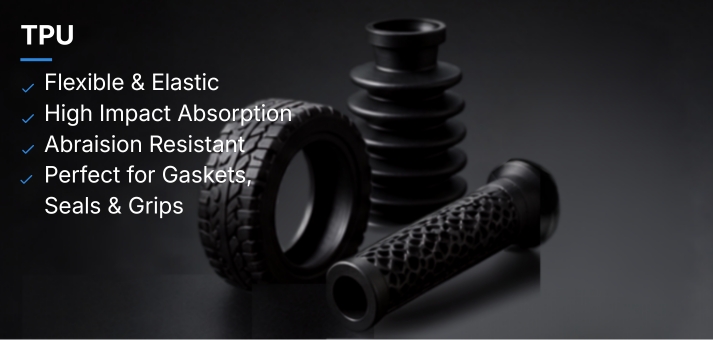
TPU

Thermoplastic Polyurethane


Nozzle Temp 220 - 240°C
Shore Hardness 85A - 95A
Extruder Direct Drive
Tensile Strength 25 MPa
Elongation at Break 600%
Shore Hardness 95A
Tear Strength 75 kN/m

Best Use Cases

Any application requiring vibration damping, impact resistance, or flexibility. Excellent for gaskets, seals, and protective wearables.

Limitations

Extremely slow print speeds required. Difficult to use with Bowden extruders as the material can jam easily.

Typical Applications

Phone Cases, Damping Pads, Footwear, Hoses

How Can We Help You?


Are you ready to get started or have a question? 
Contact us and we'll help you get started.

Get Started